"Unveiling the New Chapter: Meet the Co-hosts of 'How I Met Your Data'"

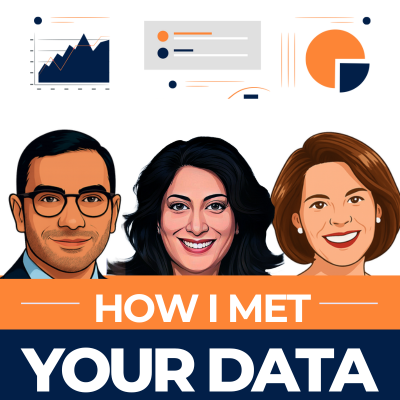


Welcome to a new chapter of 'How I Met Your Data', where we dive deeper into the real stories behind the data with our new co-hosts, Karen Meppen and Junaid. This episode explores the intersections of data leadership, AI disruption, and culture shifts, while introducing Karen and Junaid's unique perspectives and experiences in the data world.
Join us as we discuss the messy middle, transformation fatigue, and the never-ending journey of working with data. Karen shares her rich experience in optimizing processes through technology, and Junaid brings his prophetic insight into the evolving realm of AI. Together, they uncover the importance of data therapy sessions and talk about the exciting, albeit challenging, future of data management.
This episode is a blend of personal stories, professional insights, and a sneak peek into the evolving landscape of data and technology. Get ready to explore why working with data is dynamic, challenging, and yet undeniably rewarding.
0:00 Hi, I'm Anjali Bansel, and this is How I Met Your Data. If you've been with us for a while, you know that this show has always been about the real stories behind the data. The big ideas, the tough lessons, the messy middle, and the humans at the heart of it all. And that's not changing. What is changing is we're growing. This season, I'm joined by a few new voices, sharp minds, bold perspectives, and a shared belief that data is only as powerful as the people who use it. You're going to love what they bring to the table. We'll talk data leadership, AI disruption, culture shifts, transformation fatigue, and why the work never really ends, but why that's okay. Welcome to the next chapter of How I Met Your Data. Let's meet our new co-hosts.
0:46 Welcome, Karen and Janaid. I was so excited when I spoke to both of you and you were really on board to join me on this journey and continue the conversation. So, Karen, Junaid, welcome. I'd love for both of you to tell a little bit about yourself to our listeners. Sure. Well, hello. I am very excited to get started with both of you in our podcast journey. And so, just briefly about me, I am Karen Meppen. I've been working for over 20 years in data. And what does that mean, really? I started off working in finance and found myself spending more time working on optimizing and improving my processes through technology as opposed to focusing on all the assets I was supposed to be evaluating.
1:33 And that's really where I learned that I really enjoy taking the people, the processes and the technology and figuring out how to bring everyone across the finish line to meet whatever your business goals are. So I've been doing that in some version for my entire career. I'm also a fellow of information privacy, primarily because when you're working with technology, there's a lot to it more than just writing the code or putting together the infrastructure. And so that's really my sweet spot, which is understanding the technology and connecting the dots among all the different folks on the playing field, so to speak, be it. Compliance, the domain experts, and obviously the technology data teams, the software developers, et cetera.
2:17 And so I think this is a really great opportunity because also I'm often on my own or leading teams. And so it's pretty rare that I get to work or to chat with other folks who do what I do. Awesome. Thanks, Karen. Junaid? Hey, everybody. So happy to be here. I was so happy to get the call from Anjali to be a part of this podcast. I am a data nerd at heart and always looking for the excuse to talk about data and AI. So really looking forward to doing this with Anjali and Karen. I couldn't be more excited about me. I have spent now almost 30 years working most of it in data, almost all of it in financial services.
3:00 I have stood up large data governance programs, rolled out data quality frameworks, worked on basically through every discipline of data in the last few years, have pivoted very hard into AI and leveraging AI to improve data and data management. Very excited to talk about where our industry is going, what the new trends are, and maybe even having some debates about what we should be doing and where we should be going. So looking forward to it. Awesome. I love a good data debate. I also love a good data therapy session. Karen, do you want to talk a little bit about data therapy and how that brought us together? Of course. So we both worked at Slalom in different offices, but definitely were able to connect and bond very quickly over data therapy is really what we call being able to talk about all the different ways the data causes you pain or the folks you're working with and the challenges and really being able to come together without having to give a bunch of background.
4:03 Of like, let me tell you about these lineage challenges that we're working through and frustrations you have. And so it's a really great, we call it just collectively data therapy because it is something that is so beneficial. And I always feel better, at least at the end of the conversations about just really being able to let it all hang out and talk about all the different parts of working with data and how not only affects you, but everyone else around you. What I find so funny is, you know, we usually go into a data therapy session to talk about not the good, but the bad and the ugly. But I mean, Junaid, like we've had debates about data as well.
4:44 Do you find that you could benefit from a good data therapy session? Yeah, listen, I think data is very hard. Somebody once said data management or data governance isn't rocket science. It's actually much harder. And I believe it. I would say like 80% of the work that we do in data and data management AI now is very difficult just because of all the moving pieces, everything that you have to account for. And I have this joke. I say that you don't get into data for the applause and you don't get into data management for the accolades. It's very hard work. But there is this, at the end of delivering something, getting to a point where there's like a brief moment of accomplishment when you, you know, when you finish something, it's, it transfers, it's fun, but it is very, it is very hard.
5:35 And a good therapy session is, I think, needed every so often. Jenae, do you want to talk a little bit about our, our origin story? I was a guest on this podcast, which is why I enjoy, now I'm enjoying being on the other side of it and talking about what we, what we saw happening in the industry, where we saw it going and having a good discussion around, from a practitioner's perspective, what I saw and where we're going. I'd like this idea of now being on this side and co-hosting on an occasional basis to talk to other practitioners and challenge them and what I've seen and what they've seen and things like that. What excites you most about where data is going today?
6:17 Wow, that's quite there's there's a lot to get excited about. And I think you can look at it from a more pragmatic perspective of just what you can do or will be able to do soon that you weren't able to do just in the practice of data governance and strategy. But more, I think, what I'm excited about is just being able to become more independent of how it enables us. Usually, it's some version of when we're working in data governance, you know, bringing code switching and talking to everyone along the way. The technical folks, the business folks, a lot of the different folks that need to interact with the data along the way for their own obligations, as I mentioned, compliance or cybersecurity, things of that sort.
7:03 However, really all that is to serve the needs of the business folks who really just want to be able to work with their data. And I think what I'm most excited about is really how much more accessible working, interacting with the data is and will be in the near future for those that aren't technical. And being able to close the gap where you don't need to submit an IT request or talk to a lot of folks because it is already enabled within your environment. And so there are many steps, which I'm sure we'll talk about, of what it takes to actually get there. But I think that's more attainable than it ever has been.
7:45 And we can have a separate conversation about the volume of data as well, which is not, there's not less data to work with, which is a separate problem to address, right? I would say what excites me about what's coming is the not knowing of what's coming in the space of data and AI. If you told me five years ago that, you know, when I was coding a script in Python, that I could type up or through like some verbal command, talk to a chatbot about what I needed and that it would generate either Python script or SQL script. And it would give me everything I'm going to do, I don't know that I would have believed it. I mean, AI has been around for a long time.
8:27 We know that, 60s, 70s or something. And then, you know, what's happened in the last two years is not something that I saw five years ago. And I can't help but wonder what other innovation is going to happen and what other technologies are going to come out to drive this. So I think the not knowing is the, it might be the most exciting part for me. What's a really cool way, Python scripts aside, that you've leveraged generative AI in your day-to-day? You know, I'll share like an interesting experience that I had recently. So I've been using ChatGPT now for a couple of years. I'm on the paid version of it. So I have some more features and functionality.
9:10 And I use many other AI tools. But ChatGPT is the one I lean on the hardest. I use it for helping me refine emails, refine my resumes. I ask it a lot of research questions. And I feel that the tools really learned a lot about me with all the inputs that I've provided. I've shared content that I've produced from a work perspective. And I asked it a very interesting question. I asked it, how can I improve professionally and personally as a person and tell me something I don't know about myself. Without sharing the details, it was amazing in terms of its accuracy of what steps or gaps I should close because of all the LinkedIn posts that I provided, all of the resume updates that I have done through it, my areas of interest, and identifying gaps in knowledge and experience and thought leadership.
10:11 It was really wonderful, like out of the box, you know, not solving for client 360 or whatever, but just a nuanced sort of use case that anybody can can do. And I'll share sort of an interesting experience. Somebody else sent me their resume for feedback. So, yeah, I'd gotten a resume and ran it through through AI. Here's where it falls apart. It started treating that person's resume as my background. And so it was like, you have to really be careful with the data that you give it and, you know, putting the context around it. But that was a very interesting, a very interesting eye-opening experience.
10:53 I wonder if I were to do a poll, like, what would people say? Should I follow the advice or not follow the advice that it provides? But it was an interesting experience. oh wow so i like i'm so curious because i haven't actually asked chat gpt anything about myself right agree with what you got back as results in terms of like blind spots or gaps to close or things that you didn't know about yourself yeah i'll give you an example i try to post some thought leadership on on linkedin every so often it identified that i wasn't doing that enough to achieve my goal of increased followership. And I do like once every three weeks, sometimes once every five weeks.
11:35 And it advised two posts per week or two articles per week for increased followership. Like I kind of laid out what I wanted to do. You have to be very smart about the prompt saying, here's what I'm aspiring for. Increased followership on LinkedIn. tell me something that I need to do professionally and personally to achieve that and you can go down a rabbit hole and so it kind of knows that you know here's a I would give it a LinkedIn post saying help me caption help me title this or give me a catchy title for something to ID on so it would it will definitely learn about you the other thing I also did was I had many hundreds or thousands of artifacts that I've produced over the years for data on my Google Drive.
12:26 I was like, if I was going to write a book based on, you know, if I was going to write a book on data management based on all of these artifacts, because I've worked across all the disciplines, what would it look like? Could it construct the chapters and. Paragraphs and components of a book that I have enough. And I think it learned in that regard, my skill set and my capabilities and things like that. So it learns and it knows about you for sure. And I think it'll get to a point where you can ask it those sort of personal type questions. Oh, that is so interesting. Karen, have you ever asked CheckGPT anything about yourself? Well, I'm trying to think about how to answer that question because, well, the short answer is yes.
13:10 And yes, and I've really gone down the rabbit hole as it relates to, well, one, being educated so that I can enable my own goals or what I, you know, see what's possible. However, but also to figure out how to help others and to be educated about that. Right. And so I've for quite a while been spending a lot of time in many rabbit holes. And part of that is with the prompting. And one, I think, could you ever imagine that you would be so focused on something called prompting or prompt engineering, which is basically just figuring out how to talk to like an LLM? I don't know. Sometimes I feel silly about that. But I mean, there's one thing where you're structuring, you're just asking open-ended questions.
13:53 And it's another thing that I've learned, which is very comprehensive, structured for the LLM type prompts to get unique information that can be very comprehensive at best. That can be as it relates to a directed, well, like on LinkedIn, but also as it relates to like self-improvement and other options of, you know, your career trajectory. And it's just amazing what is possible when you really start optimizing the prompt engineering, you know, for open AI, let's say. Or chatGPT, that that's an art unto itself for what it can yield.
14:34 And I think that's really what I think is kind of the gap that most people who are just starting off don't even understand of like what's possible is only limited by how how much you want to get into it and it's and I think that's really what I've learned a lot myself which is how to improve a lot of the prompts about you know every realm of your life as it relates to like supporting my kids or like jeez, I don't even know what I need to do as it relates to helping them on a particular topic of, you know, giving a structured prompt about their homework or how to get them out of a rut. We're like, My son really is not into doing his spelling, practicing each week.
15:15 And so taking into account like his learning style, his age, you know, and also just other parts that influence learning and how to engage him. And the response I got was like, wow, I wonder why I haven't been doing this earlier, right? I think that's a very interesting use case is like, how do I leverage this technology to manage a rambunctious five-year-old? It might be my next experiment. It's a slippery slope, I'll tell you. I want to start doing that. And then the counterpoint from a privacy standpoint is just being cautious about what you share. Because once you hit the submit button, it's gone and forever.
15:59 You can't get it back. And it's going to be available forever and ever. So much of what we do is not just work-related. It isn't just data. So tell us a little bit about, just about yourselves outside of work. What do you like to do? So I have two kids, seven and just turned 10. And so I live in Las Vegas. So no, I don't live on the strip. I live in a suburban neighborhood near the Red Rocks, which is really great to spend time outside. I think that's what's lesser known about being in Southern Nevada is just what is just around for you to explore and hike. and also just going to Little League games with my.
16:43 For my son's team, and then really focusing on having quality time with the kids, spending a lot of time in the kitchen. And hot tip, it's interesting what you can put in for prompts and open AI for coming up with recipes. It could be a little bit nerve wracking, especially if you have a big meal you're preparing your meal. If it's basic things like eggs or other things that have really gone up in price or are scarce in whatever it is you're having for a Friday night. So Janine, what about you? Tell us a little bit about yourself. Well, you know, the only thing I could do in the kitchen is open a refrigerator and put something in a microwave.
17:24 So I have no skill set there and I don't think AI can help me in any capacity there. You know, it's funny. Before my son was born, I was an avid mountain biker. I loved motorcycling. I've done a cross-country motorcycle trip, which is very memorable. I love all sports. I play a lot of basketball and soccer. I will say since my son has been born, I do everything with him. My life seems to revolve around him swimming after work with him, soccer with him. I think I'm a chauffeur now. I chauffeur him around all over the place. And I enjoy every minute of it. Enjoy being a dad. Enjoy spending time with him. and hopefully raising a good person.
18:09 All right, both. Well, thank you for taking the time to introduce yourselves to our listeners. And I am looking forward to what this season brings us.